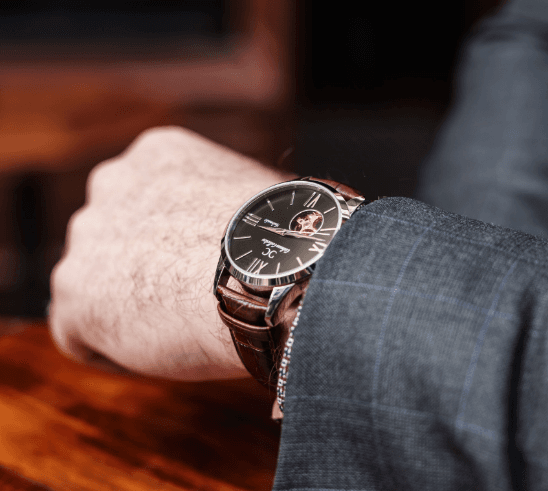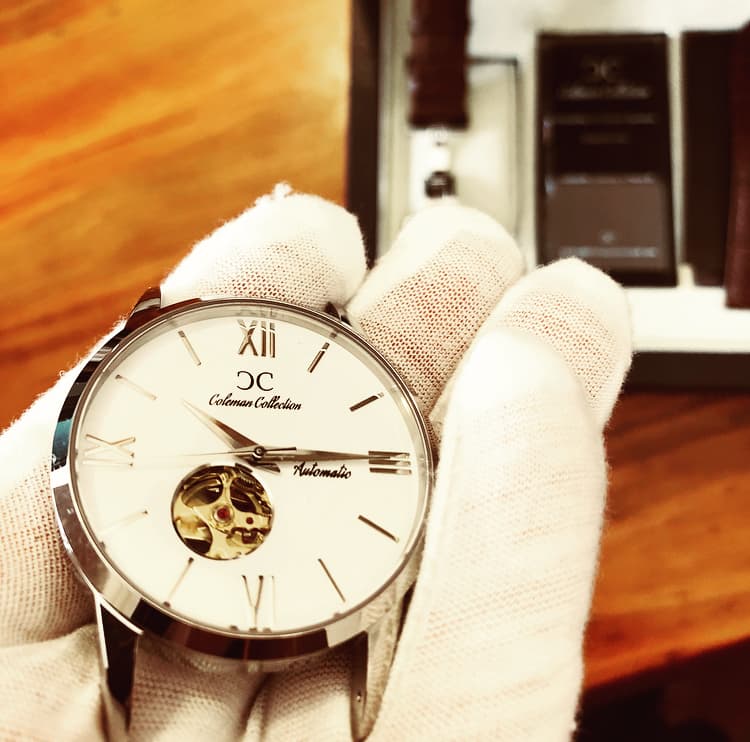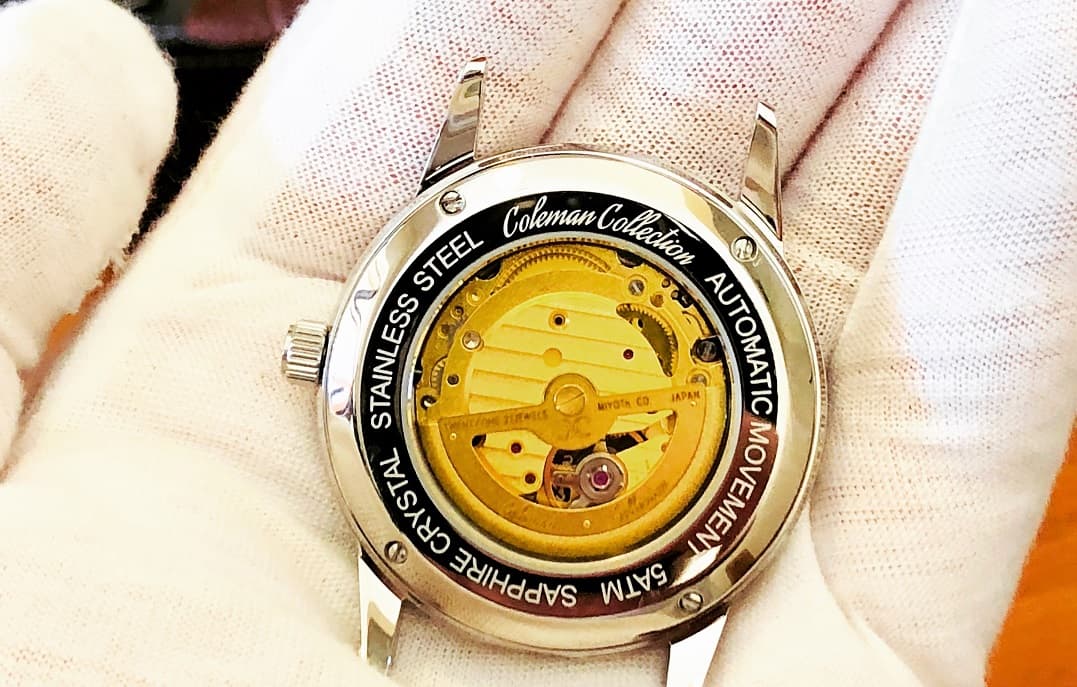
An automatic mechanical watch is one of the few objects you can own that creates something from nothing — it transforms the invisible kinetic energy of your daily movements into the steady, precise measurement of time. No battery, no circuit board, no charging cable. Just over a hundred hand-assembled components working in mechanical harmony on your wrist.
In an age where every device demands to be charged, updated, and eventually replaced, the automatic watch stands apart. It runs on you.
How an Automatic Movement Works
At the heart of every automatic watch is the mainspring — a tightly coiled strip of metal that stores energy as it's wound. In a manual-wind watch, you'd turn the crown by hand. In an automatic, a semicircular weight called a rotor does the winding for you.
The rotor is mounted on a bearing at the centre of the movement. As you move your wrist — walking, gesturing, reaching for your coffee — gravity pulls the rotor, causing it to spin. That rotation is transferred through a series of reduction gears to the mainspring, tightening it incrementally throughout the day.
The stored energy is then released at a precisely controlled rate through the escapement — a mechanism that alternately locks and releases the gear train, creating that distinctive ticking rhythm. In most modern movements, this happens at 28,800 vibrations per hour (4 Hz), meaning the balance wheel oscillates back and forth eight times every second.
The automatic movement doesn't fight against your daily life. It draws energy from it. Every step, every gesture, every handshake winds the spring a fraction tighter.
Automatic vs Quartz: A Different Philosophy
The quartz revolution of the 1970s nearly destroyed the mechanical watch industry. Quartz movements — powered by a battery sending electrical pulses through a vibrating quartz crystal — were cheaper to produce, more accurate, and required almost no maintenance.
On paper, quartz wins every measurable category. But watchmaking was never only about measurement.
| Feature | Automatic Mechanical | Quartz |
|---|---|---|
| Power source | Your wrist movement | Battery (1-3 year lifespan) |
| Accuracy | -10 to +30 seconds/day | ±1-2 seconds/month |
| Lifespan | Decades to centuries with service | 10-15 years (circuit degradation) |
| Components | 130+ hand-assembled parts | 10-30 parts, machine-assembled |
| Serviceability | Fully rebuildable | Disposable module replacement |
| Sweep | Smooth, continuous | Tick-tick-tick (1 second steps) |
The difference between automatic and quartz is the difference between a vinyl record and a digital stream. The digital version is objectively more precise. But precision isn't the only thing that matters.
An automatic watch is alive. The sweep of the seconds hand is smooth and continuous because the balance wheel is oscillating eight times per second, not stepping once. When you hold a mechanical watch to your ear, you hear the escapement — a physical, tangible heartbeat that's been keeping time since before electronics existed.
The Movements Inside Coleman Collection Watches
Coleman Collection uses two families of automatic movements, each chosen for reliability, accuracy, and serviceability.
Miyota Movements
The Miyota 9039 is a Japanese automatic movement with a 42-hour power reserve, operating at 28,800 vibrations per hour. It includes hacking seconds — meaning the seconds hand stops when you pull the crown, allowing you to set the time to the exact second. Miyota movements are manufactured by Citizen Watch Company in Saitama, Japan, and are among the most reliable workhorse calibers in watches under $1,000.
The Miyota 82S0 is the open-heart variant, featuring a visible balance wheel aperture on the dial side. It operates at 21,600 vph with a 40-hour power reserve. This is the movement that gives the Coleman Collection Open-Heart models their signature window into the mechanical heart of the watch.
Sellita Movements
The Sellita SW200-1 is a Swiss-made automatic movement, manufactured in La Chaux-de-Fonds, Switzerland. With a 38-hour power reserve and 28,800 vph frequency, it's the Swiss-made alternative to the legendary ETA 2824-2 — sharing the same architecture, meaning parts availability and serviceability are excellent worldwide.
The Sellita SW300-1 is the premium option — a slimmer caliber with a 42-hour power reserve, designed for dress watches where case thickness matters.
Why Mechanical Watches Matter Now More Than Ever
We live surrounded by disposable technology. Phones are replaced every two years. Laptops become obsolete in five. Even electric cars have battery degradation curves that limit their useful life.
A mechanical watch is a deliberate rejection of that cycle. It's an object designed to be repaired, not replaced. A watchmaker can disassemble a Sellita SW200-1, clean every component, replace worn parts, and reassemble it to factory specification — decade after decade. The same movement that tells time today can tell time for your children and grandchildren.
There's also something deeply satisfying about wearing a machine that works without external power. Your automatic watch is a closed system — it takes energy from your body, stores it mechanically, and returns it as information. No server, no update, no subscription. Just you and the watch.
Owning an automatic watch is a statement: that some things are worth doing the harder way, because the harder way produces something that lasts.
Caring for Your Automatic Watch
An automatic movement requires minimal care, but a few habits will extend its life significantly:
- Wear it regularly. Most automatics have a 38-42 hour power reserve. Daily wear keeps the mainspring wound and the lubricants distributed evenly across the movement.
- Avoid extreme shocks. While modern movements are reasonably shock-resistant, slamming your wrist against a hard surface can displace the balance staff or damage the escapement.
- Service every 5-7 years. A full service involves disassembly, ultrasonic cleaning, re-lubrication, and reassembly. This prevents dried lubricants from causing premature wear on the gear train.
- Store it properly. If you're not wearing your watch for an extended period, lay it flat in a cool, dry place. There's no need for a watch winder — letting the movement stop is perfectly safe.
The automatic watch is not for everyone. If you need atomic accuracy or the convenience of never thinking about timekeeping, buy a smartwatch. But if you want to wear something that was engineered to outlast you — something with a mechanical soul that runs on nothing but your own momentum — an automatic watch is the most meaningful thing you can put on your wrist.
Frequently Asked Questions
An automatic watch uses a weighted rotor that spins as you move your wrist throughout the day. This rotor winds the mainspring, which stores energy and releases it through a series of gears and an escapement to regulate the movement of the hands. A typical automatic movement contains over 130 individual components working in concert.
No. Automatic watches are entirely mechanical — they are powered by the motion of your wrist. As long as you wear the watch regularly, it will continue running. If left unworn, most automatic watches will run for 38 to 42 hours before stopping, at which point you simply set the time and wear it again.
Modern automatic movements like the Miyota 9039 and Sellita SW200-1 achieve accuracy of approximately -10 to +30 seconds per day. While this is less precise than a quartz watch (which loses only 1-2 seconds per month), the accuracy of mechanical timekeeping is remarkable given that it's achieved entirely through physical engineering — no electronics involved.
Automatic watches are engineered to last decades with proper maintenance, unlike quartz watches which rely on disposable batteries and electronic circuits with limited lifespans. A well-maintained automatic movement can be serviced and restored indefinitely, making it a genuinely long-term investment and a meaningful object to pass down.