Every Coleman Collection watch is the sum of deliberate choices — each material selected not because it's the cheapest option or the most exotic, but because it's the right one for a timepiece designed to be worn every day for decades.
This is what goes into the watch on your wrist.
The Case: 316L Surgical-Grade Stainless Steel
The case of every Coleman Collection watch is machined from 316L stainless steel — the same alloy used by Rolex, Omega, Tudor, and virtually every serious watchmaker for their steel sport and dress watches.
316L is an austenitic stainless steel containing approximately 16-18% chromium, 10-14% nickel, and 2-3% molybdenum. The chromium creates a self-healing oxide layer on the surface that resists corrosion. The molybdenum provides additional resistance to pitting and crevice corrosion — particularly important for a watch that's exposed to sweat, water, and varying temperatures daily.
The "L" in 316L stands for low carbon (0.03% maximum), which prevents a phenomenon called sensitisation — where carbon reacts with chromium at high temperatures, creating weak spots in the steel's corrosion resistance. This makes 316L more durable than standard 316 in long-term use.
316L stainless steel is also classified as surgical-grade — it's the same material used in medical implants, surgical instruments, and marine hardware where corrosion resistance is critical.
Case Finishing
Each case undergoes a multi-stage finishing process:
- CNC machining: The raw case is cut from a steel billet using computer-controlled lathes and mills, achieving dimensional accuracy to within 0.02mm
- Polished surfaces: The case sides and bezel receive a mirror polish using progressively finer abrasives, ending with a jeweller's rouge compound
- Brushed surfaces: The case top and lugs receive a linear brushed finish using Scotch-Brite pads at a controlled angle, creating a satin texture that contrasts with the polished surfaces
- PVD coating (Black and Rose variants): A Physical Vapour Deposition process applies a thin, extremely hard coating of titanium nitride or similar compound, providing colour without paint and scratch resistance that exceeds raw steel
The Crystal: Sapphire
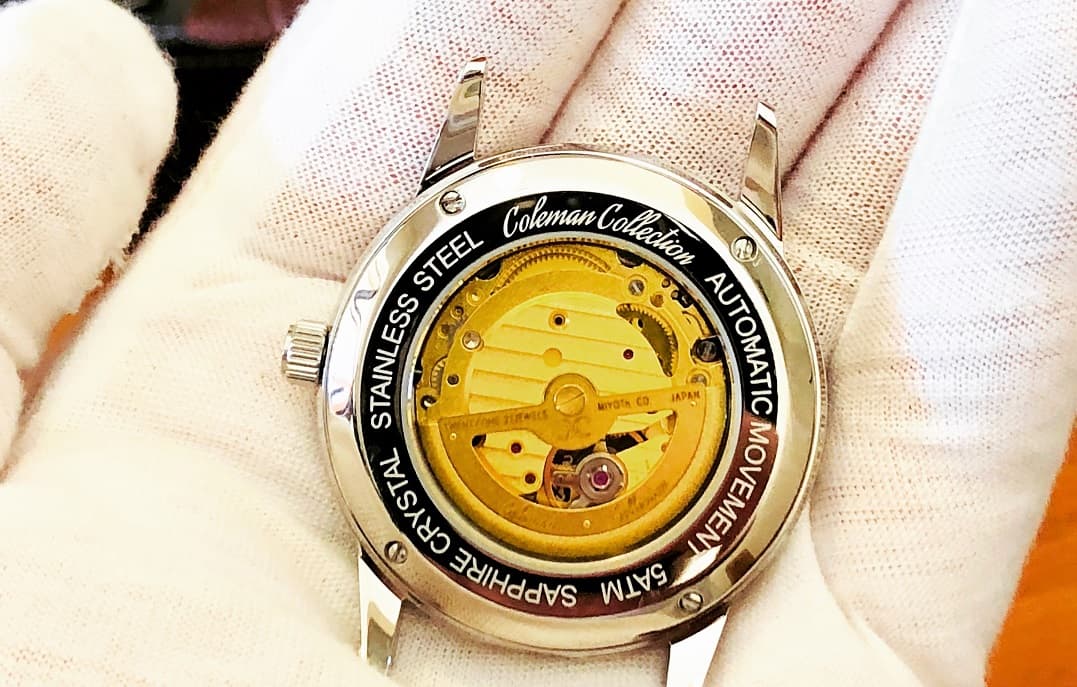
Every Coleman Collection watch uses sapphire crystal — not mineral glass, not acrylic, not "sapphire-coated" glass. Genuine synthetic sapphire.
Sapphire is crystalline aluminium oxide (Al₂O₃), the same material as natural rubies and sapphires, grown in a laboratory under controlled conditions. It rates 9 on the Mohs hardness scale — only diamond (10) is harder. For practical purposes, this means the crystal is virtually scratch-proof in normal wear. The only common material that can scratch sapphire is diamond or another sapphire.
Each crystal is cut to size, polished to optical clarity, and treated with an anti-reflective coating on the underside. This AR coating reduces light reflection from approximately 8% to under 1%, dramatically improving dial legibility in bright conditions.
The Dial
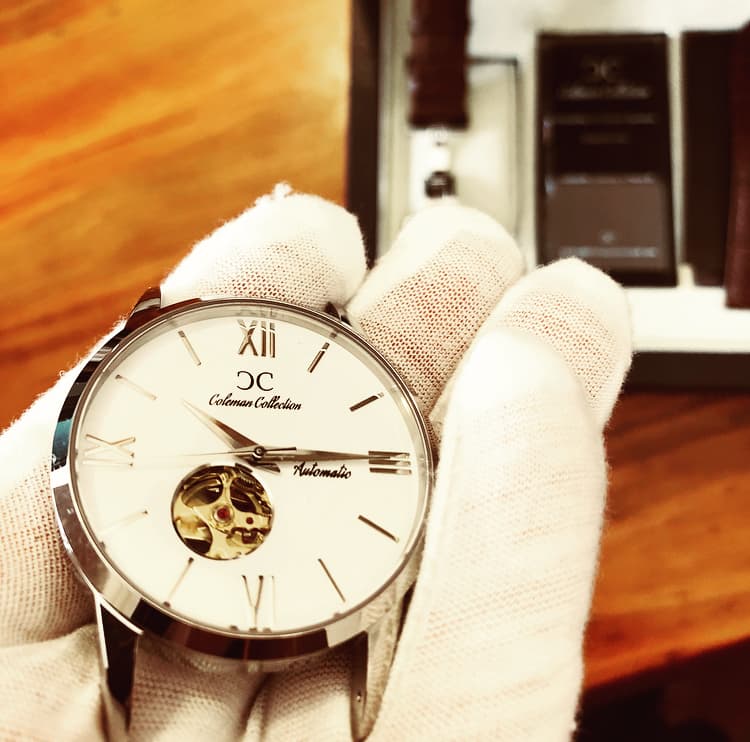
The dial is the face of the watch — and for the Coleman Collection Open-Heart models, it's where the mechanical movement becomes visible.
Each dial starts as a brass blank, stamped to shape and then finished through a multi-step process:
- Surface treatment: The base colour is applied through electroplating (for metallic finishes) or lacquer (for colours like Midnight Blue and Racing Green)
- Index application: The hour markers and indices are printed or applied. Applied indices are individual metal pieces attached to the dial surface, creating a three-dimensional quality that printed markers can't match
- Open-heart aperture: For the Open-Heart models, a window is cut at the 12 o'clock position, revealing the balance wheel of the movement beneath. The edges of this aperture are finished to prevent any sharp edges from interfering with the movement
- Luminous material: The hands and selected indices are filled with Super-LumiNova — a non-radioactive photoluminescent compound that absorbs light and glows in darkness
Water Resistance: 5 ATM
Every Coleman Collection watch is rated to 5 ATM (50 metres) of water resistance. This is achieved through a system of gaskets and seals at every potential entry point for moisture:
- Caseback gasket: A rubber compression gasket between the caseback and case body
- Crown seal: An O-ring gasket around the crown stem that compresses when the crown is pushed in
- Crystal gasket: A thin gasket between the sapphire crystal and the case bezel
Each completed watch is tested in a pressure chamber that simulates the rated depth. The test confirms that no moisture enters the case under pressure. Watches that fail this test are disassembled, resealed, and retested.
What 5 ATM means in practice: You can wear your Coleman Collection watch in the rain, wash your hands, and survive accidental splashes. Brief, shallow swimming is generally safe. However, 5 ATM is not designed for diving, snorkelling, or sustained submersion. The dynamic pressure of a diving arm stroke or the impact of jumping into water can exceed the static pressure rating.
The Strap
Coleman Collection offers five strap options, each selected for quality and wearability:
Leather straps (Black, Saddle Brown, Cognac Tan) are made from genuine leather with a padded construction. The underside uses a soft leather lining to prevent irritation. Each strap uses a traditional pin buckle in brushed stainless steel.
Steel bracelet uses 316L stainless steel links with a fold-over clasp and push-button release. The links are individually finished — polished centre links with brushed outer links — creating the same contrast as the case.
Vulcanised rubber is a high-density natural rubber compound that's been vulcanised (heat-treated with sulphur) for durability and shape retention. It's hypoallergenic, sweat-resistant, and maintains its shape in heat and cold. The texture is a fine grain that prevents the strap from sticking to skin.
Assembly and Quality Control
Final assembly brings together the case, movement, dial, hands, crystal, and strap into a complete timepiece. This is done by hand — the movement is carefully seated in the case, the dial and hands are aligned, the crystal is pressed into place, and the caseback is sealed.
Each watch then undergoes a quality control process:
- Visual inspection — checking for dial alignment, hand spacing, crystal seating, and cosmetic defects
- Timing test — the watch is run on a timing machine in multiple positions to verify accuracy is within specification
- Water resistance test — pressure testing as described above
- Function test — checking crown operation, date change (where applicable), and rotor winding
- Final inspection — a last visual check before the watch is placed in its presentation box
The result is a timepiece where every component has been chosen with intention and assembled with care — designed not to impress for a moment, but to perform for a lifetime.
Frequently Asked Questions
Every Coleman Collection watch uses sapphire crystal — synthetic corundum rated 9 on the Mohs hardness scale, making it the second hardest transparent material after diamond. This crystal is virtually scratch-proof in daily wear and is treated with an anti-reflective coating on the underside to reduce glare and improve dial legibility.
316L is a low-carbon, molybdenum-bearing austenitic stainless steel with superior corrosion resistance. It contains approximately 16-18% chromium, 10-14% nickel, and 2-3% molybdenum. The 'L' designation means low carbon content (0.03% max), which improves weldability and reduces sensitisation. It's the same alloy used by Rolex, Omega, and other premium watchmakers for their cases.
The watch cases are precision-machined using CNC technology and then hand-finished — polished and brushed by skilled technicians to achieve the specific surface textures on each case. The movements are assembled at their respective factories (Miyota in Japan, Sellita in Switzerland) under controlled conditions. Final assembly — fitting the movement into the case, setting the dial, attaching the hands, and sealing the caseback — is done by hand.
Water resistance to 5 ATM (50 metres) is achieved through a combination of gaskets and seals at every potential entry point: the caseback uses a compression gasket, the crown uses an O-ring seal, and the crystal is pressure-fitted into the case with its own gasket. Each completed watch is pressure-tested to verify the seal integrity before shipping.