Water resistance is one of the most misunderstood specifications in watchmaking. A watch rated to "50 metres" cannot safely be taken to a depth of 50 metres. A watch rated to "100 metres" is not a diving watch. The numbers on the caseback tell a specific technical story — but not the one most people assume.
Here's what the ratings actually mean, and what you can safely do with your watch at each level.
How Water Resistance Is Tested
Water resistance is tested by placing the sealed watch in a pressure chamber and applying static pressure. The key word is static — the watch sits motionless while uniform pressure is applied from all directions.
A 5 ATM test applies 5 atmospheres of pressure (approximately 73.5 psi or 5.07 bar), equivalent to the static pressure experienced at 50 metres underwater. If no moisture enters the case, the watch passes.
What this test does not simulate:
- The dynamic pressure of a swimming arm stroke hitting the water surface
- The impact force of jumping or diving into water
- The pressure spike when a shower jet hits the watch directly
- The effect of temperature changes on gasket expansion and contraction
- The long-term degradation of gaskets over months and years of wear
Water resistance ratings represent what the watch can withstand at the moment it leaves the factory, under controlled laboratory conditions. Real-world performance is always lower.
The Rating Scale
| Rating | Static Pressure | Metres Equivalent | What You Can Safely Do |
|---|---|---|---|
| 1 ATM / 10m | 1 bar | 10 metres | Dust and accidental splash only |
| 3 ATM / 30m | 3 bar | 30 metres | Rain, handwashing, light splashes |
| 5 ATM / 50m | 5 bar | 50 metres | Rain, handwashing, brief shallow swimming |
| 10 ATM / 100m | 10 bar | 100 metres | Swimming, snorkelling, water sports |
| 20 ATM / 200m | 20 bar | 200 metres | Recreational scuba diving |
| 30+ ATM / 300m+ | 30+ bar | 300+ metres | Professional diving (with helium escape valve) |
Coleman Collection: 5 ATM Explained
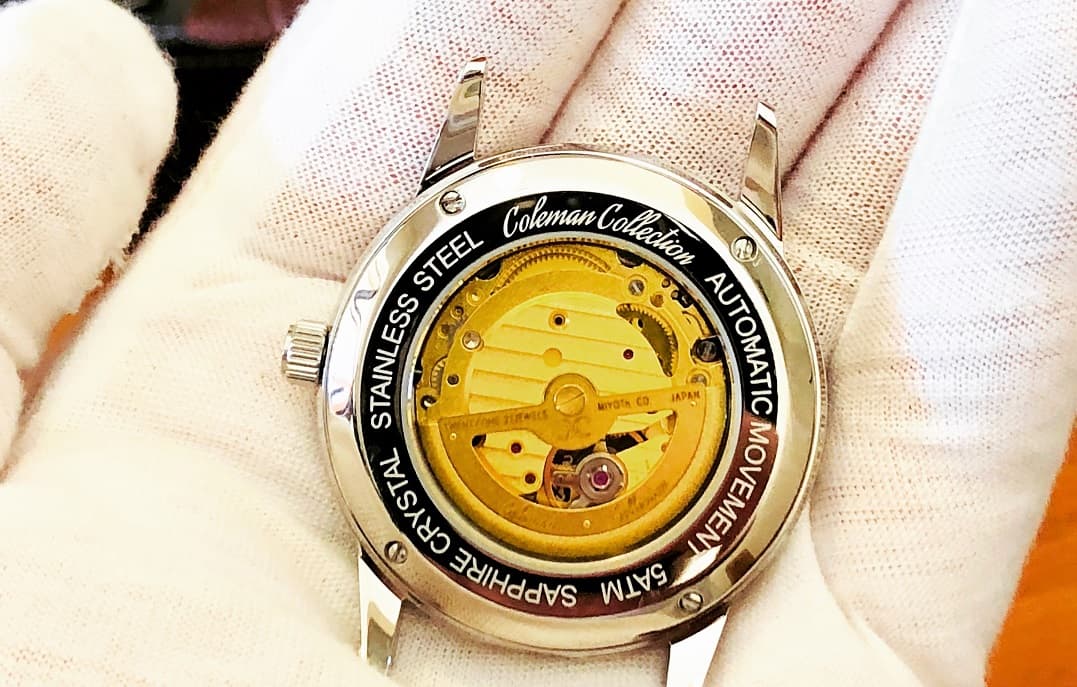
Every Coleman Collection watch is rated to 5 ATM (50 metres). In practical terms, this means:
Safe:
- Wearing in rain and storms
- Washing hands with soap and water
- Accidental splashes and brief submersion
- Getting caught in a sudden downpour
- Wearing while doing dishes (though we'd recommend removing it to avoid scratches from cookware)
Use caution:
- Brief swimming in calm water (pool or calm ocean) — generally safe but pushing the limits
- Light water activities like paddleboarding or kayaking — acceptable if you're not falling in
Avoid:
- Sustained swimming or lap swimming
- Diving or jumping into water
- Snorkelling or any underwater activity
- Water sports (surfing, waterskiing, jet skiing)
- Hot showers or saunas — heat expands gaskets and can compromise the seal
- Operating the crown while the watch is wet — this bypasses the crown seal
Understanding Units: ATM vs Bar vs Metres
The three units used in water resistance are essentially interchangeable at watchmaking scales:
- 1 ATM = 1.01325 bar = 10.33 metres of water
- 1 bar = 0.9869 ATM = 10.20 metres of water
- 10 metres of water = 0.9678 ATM = 0.9807 bar
For practical purposes: 1 ATM ≈ 1 bar ≈ 10 metres
Watch manufacturers use these interchangeably. A "50m" watch, a "5 ATM" watch, and a "5 bar" watch all have the same water resistance. The metres figure is particularly misleading because it suggests a diving depth — it is not. It's simply a mathematical conversion of the static pressure test value.
How Water Resistance Degrades
Water resistance is not permanent. The gaskets that seal your watch are made from rubber or synthetic elastomers, and they deteriorate over time through:
- Ageing: Rubber naturally loses elasticity over years, even without use
- UV exposure: Sunlight breaks down rubber compounds
- Chemical exposure: Sweat, sunscreen, soap, chlorine, and salt water all accelerate gasket degradation
- Temperature cycling: Repeated heating and cooling (wearing in the sun, then air-conditioned offices) causes gaskets to expand and contract, gradually reducing their sealing effectiveness
- Impact: Dropping the watch or striking it against a hard surface can subtly deform the case or shift a gasket
Maintaining Water Resistance
- Service the gaskets every 5-7 years during your regular movement service. A watchmaker will replace all gaskets and pressure-test the case.
- Never operate the crown while the watch is wet or near water. The crown seal is the most vulnerable point — pulling the crown out to adjust the time breaks the seal.
- Rinse after salt water or chlorine exposure. Both are corrosive to gaskets and steel. A brief rinse under fresh water is sufficient.
- Avoid temperature shocks. Don't wear your watch into a sauna or hot tub, and avoid moving from extreme heat to cold water quickly.
The "Shower Test" Myth
A common question: "Can I shower with my 5 ATM watch?"
Technically, the static pressure of shower water is minimal — well within 5 ATM. But showering introduces two risks that static pressure testing doesn't account for:
- Hot water and steam cause gaskets to expand, potentially creating microscopic gaps in the seal
- Soap and shampoo are surfactants that reduce the surface tension of water, allowing smaller water molecules to penetrate gaps that would otherwise repel pure water
Most watchmakers — including those at far higher price points than ours — recommend removing your watch before showering. It takes five seconds and eliminates a genuine risk.
When to Upgrade Your Water Resistance Needs
If your lifestyle regularly involves water activities, a 5 ATM watch may not be the right tool. Consider:
- For regular swimming: Look for 10 ATM / 100m minimum
- For scuba diving: 20 ATM / 200m minimum, with a unidirectional rotating bezel
- For professional diving: 30 ATM / 300m+ with a helium escape valve
The Coleman Collection Sovereign is designed as a daily dress-to-casual watch, not a dive instrument. Its 5 ATM rating provides peace of mind for the water encounters of normal daily life — rain, handwashing, unexpected splashes — without adding the bulk and complexity that higher water resistance ratings require.
For everything else, there's a watch configurator where you can build the exact timepiece for your needs.
Frequently Asked Questions
A 5 ATM (50 metre) water resistance rating means the watch can withstand brief, shallow swimming in calm water. However, it is not designed for sustained swimming, diving, snorkelling, or water sports. The dynamic pressure of swimming strokes and jumping into water can exceed the static pressure the rating was tested at. For regular swimming, a 10 ATM (100 metre) rating is recommended.
Water resistance is tested by placing the watch in a sealed chamber and applying static pressure equivalent to a certain depth. A 5 ATM rating means the watch survived 5 atmospheres of static pressure (equivalent to 50 metres depth). Critically, this is static pressure only — it does not account for the dynamic forces of movement, impact, or temperature changes that occur during actual water activities.
Water resistance degrades over time as gaskets age, dry out, and lose elasticity. To maintain your water resistance rating: have the gaskets inspected during every service (every 5-7 years), never operate the crown while the watch is wet or submerged, avoid exposing the watch to sudden temperature changes (like a hot shower followed by cold water), and rinse the watch in fresh water after exposure to salt water or chlorine.
ATM (atmospheres), bar, and metres are all used to express water resistance, and they're essentially interchangeable at the values used in watchmaking: 1 ATM ≈ 1 bar ≈ 10 metres of water depth. A 5 ATM watch is rated to 5 bar or 50 metres. A 10 ATM watch is rated to 10 bar or 100 metres. The metres figure does NOT mean you can dive to that depth — it's a static pressure test equivalent.